Showing posts with label Pope Emeritus Benedict XVI. Show all posts

Sunday, September 28, 2014

Pope Benedict XVI (Emeritus)


This is a small video of a collection of photos from the Pontificate of Pope Benedict XVI (Emeritus).  Today Pope Emeritus Benedict XVI will attend a Holy Mass with Pope Francis for the elderly.

Following quotes from Pope Emeritus Benedict XVI

“If you follow the will of God, you know that in spite of all the terrible things that happen to you, you will never lose a final refuge. You know that the foundation of the world is love, so that even when no human being can or will help you, you may go on, trusting in the One that loves you.” 

“It is theologically and anthropologically important for woman to be at the center of Christianity. Through Mary, and the other holy women, the feminine element stands at the heart of the Christian religion.” 

“Truth is not determined by a majority vote.” 

“Something I constantly notice is that unembarrassed joy has become rarer. Joy today is increasingly saddled with moral and ideological burdens, so to speak. When someone rejoices, he is afraid of offending against solidarity with the many people who suffer. I don't have any right to rejoice, people think, in a world where there is so much misery, so much injustice.
I can understand that. There is a moral attitude at work here. But this attitude is nonetheless wrong. 

The loss of joy does not make the world better - and, conversely, refusing joy for the sake of suffering does not help those who suffer. The contrary is true. The world needs people who discover the good, who rejoice in it and thereby derive the impetus and courage to do good. Joy, then, does not break with solidarity. When it is the right kind of joy, when it is not egotistic, when it comes from the perception of the good, then it wants to communicate itself, and it gets passed on. In this connection, it always strikes me that in the poor neighborhoods of, say, South America, one sees many more laughing happy people than among us. Obviously, despite all their misery, they still have the perception of the good to which they cling and in which they can find encouragement and strength.
In this sense we have a new need for that primordial trust which ultimately only faith can give. That the world is basically good, that God is there and is good. That it is good to live and to be a human being. This results, then, in the courage to rejoice, which in turn becomes commitment to making sure that other people, too, can rejoice and receive good news.” 


Tuesday, March 4, 2014

Reading for Lent......

Recommended Reading for Lent -  
Jesus of Nazareth - Pope (Emeritus) Benedict XVI
(Holy Week from Jesus entrance to Jerusalem to the Resurrection)


Monday, February 24, 2014

The Saints in Heaven our Friends and Models for Life - Pope Emeritus Benedict XVI

Homily on the Solemnity of All Saints in 2006 given by Pope Benedict XVI (now Emeritus) 

Dear Brothers and Sisters,

Our Eucharistic celebration began with the exhortation: "Let us all rejoice in the Lord". The liturgy invites us to share in the heavenly jubilation of the Saints, to taste their joy. The Saints are not a small caste of chosen souls but an innumerable crowd to which the liturgy urges us to raise our eyes. This multitude not only includes the officially recognized Saints, but the baptized of every epoch and nation who sought to carry out the divine will faithfully and lovingly. We are unacquainted with the faces and even the names of many of them, but with the eyes of faith we see them shine in God's firmament like glorious stars.

Today, the Church is celebrating her dignity as "Mother of the Saints, an image of the Eternal City" (A.Manzoni), and displays her beauty as the immaculate Bride of Christ, source and model of all holiness. She certainly does not lack contentious or even rebellious children, but it is in the Saints that she recognizes her characteristic features and precisely in them savours her deepest joy.

In the first reading, the author of the Book of Revelation describes them as "a great multitude which no man could number, from every nation, from all tribes and peoples and tongues" (Rv 7: 9).

This people includes the Saints of the Old Testament, starting with the righteous Abel and the faithful Patriarch, Abraham, those of the New Testament, the numerous early Christian Martyrs and the Blesseds and Saints of later centuries, to the witnesses of Christ in this epoch of ours.

They are all brought together by the common desire to incarnate the Gospel in their lives under the impulse of the Holy Spirit, the life-giving spirit of the People of God.

But "why should our praise and glorification, or even the celebration of this Solemnity, mean anything to the Saints?". A famous homily of St Bernard for All Saints' Day begins with this question. It could equally well be asked today. And the response the Saint offers us is also timely: "The Saints", he says, "have no need of honour from us; neither does our devotion add the slightest thing to what is theirs.... But I tell you, when I think of them, I feel myself inflamed by a tremendous yearning" (Disc. 2, Opera Omnia Cisterc. 5, 364ff.).

This, then, is the meaning of today's Solemnity: looking at the shining example of the Saints to reawaken within us the great longing to be like them; happy to live near God, in his light, in the great family of God's friends. Being a Saint means living close to God, to live in his family. And this is the vocation of us all, vigorously reaffirmed by the Second Vatican Council and solemnly proposed today for our attention.

But how can we become holy, friends of God? We can first give a negative answer to this question: to be a Saint requires neither extraordinary actions or works nor the possession of exceptional charisms. Then comes the positive reply: it is necessary first of all to listen to Jesus and then to follow him without losing heart when faced by difficulties. "If anyone serves me", he warns us, "he must follow me; and where I am, there shall my servant be also; if any one serves me, the Father will honour him" (Jn 12: 26).

Like the grain of wheat buried in the earth, those who trust him and love him sincerely accept dying to themselves. Indeed, he knows that whoever seeks to keep his life for himself loses it, and whoever gives himself, loses himself, and in this very way finds life (cf. Jn 12: 24-25).

The Church's experience shows that every form of holiness, even if it follows different paths, always passes through the Way of the Cross, the way of self-denial. The Saints' biographies describe men and women who, docile to the divine plan, sometimes faced unspeakable trials and suffering, persecution and martyrdom. They persevered in their commitment: "they... have come out of the great tribulation", one reads in Revelation, "they have washed their robes and made them white in the blood of the Lamb" (Rv 7: 14). Their names are written in the book of life (cf. Rv 20: 12) and Heaven is their eternal dwelling-place.

The example of the Saints encourages us to follow in their same footsteps and to experience the joy of those who trust in God, for the one true cause of sorrow and unhappiness for men and women is to live far from him.

Holiness demands a constant effort, but it is possible for everyone because, rather than a human effort, it is first and foremost a gift of God, thrice Holy (cf. Is 6: 3). In the second reading, the Apostle John remarks: "See what love the Father has given us, that we should be called children of God; and so we are" (I Jn 3: 1).
It is God, therefore, who loved us first and made us his adoptive sons in Jesus. Everything in our lives is a gift of his love: how can we be indifferent before such a great mystery? How can we not respond to the Heavenly Father's love by living as grateful children? In Christ, he gave us the gift of his entire self and calls us to a personal and profound relationship with him.

Consequently, the more we imitate Jesus and remain united to him the more we enter into the mystery of his divine holiness. We discover that he loves us infinitely, and this prompts us in turn to love our brethren. Loving always entails an act of self-denial, "losing ourselves", and it is precisely this that makes us happy.
Thus, we have come to the Gospel of this feast, the proclamation of the Beatitudes which we have just heard resound in this Basilica.

Jesus says: Blessed are the poor in spirit, blessed those who mourn, the meek; blessed those who hunger and thirst for justice, the merciful; blessed the pure in heart, the peacemakers, the persecuted for the sake of justice (cf. Mt 5: 3-10).

In truth, the blessed par excellence is only Jesus. He is, in fact, the true poor in spirit, the one afflicted, the meek one, the one hungering and thirsting for justice, the merciful, the pure of heart, the peacemaker. He is the one persecuted for the sake of justice.
The Beatitudes show us the spiritual features of Jesus and thus express his mystery, the mystery of his death and Resurrection, of his passion and of the joy of his Resurrection. This mystery, which is the mystery of true blessedness, invites us to follow Jesus and thus to walk toward it.

To the extent that we accept his proposal and set out to follow him - each one in his own circumstances - we too can participate in his blessedness. With him, the impossible becomes possible and even a camel can pass through the eye of a needle (cf. Mk 10: 25); with his help, only with his help, can we become perfect as the Heavenly Father is perfect (cf. Mt 5: 48).

Dear brothers and sisters, we are now entering the heart of the Eucharistic celebration that encourages and nourishes holiness. In a little while, Christ will make himself present in the most exalted way, Christ the true Vine to whom the faithful on earth and the Saints in Heaven are united like branches.

Thus, the communion of the pilgrim Church in the world with the Church triumphant in glory will increase.
In the Preface we will proclaim that the Saints are friends and models of life for us. Let us invoke them so that they may help us to imitate them and strive to respond generously, as they did, to the divine call.
In particular, let us invoke Mary, Mother of the Lord and mirror of all holiness. May she, the All Holy, make us faithful disciples of her Son Jesus Christ! Amen.


Picture above on right of Bl. Pier Giorgio Frassati

Sunday, January 5, 2014

Monsignor George Ratzinger


Pray for Monsignor George Ratzinger who was recently admitted to the Gemelli hospital in Rome for some tests. He has since returned to his brother, Pope Emeritus Benedict's residence yesterday, where he will celebrate his 90th birthday on the 15th January.

May the Lord bless them both abundantly.  

Tuesday, December 31, 2013

Humility and one of the greatest of Men, Pope Emeritus Benedict XVI


Our Lady spoke to St. Faustina on true humility which is in doing Gods will and putting aside ones self.

When I was left alone with the Blessed Virgin, She instructed me concerning the interior life. She said, "The soul's true greatness is in loving God and in humbling oneself in His presence, completely forgetting oneself and believing oneself to be nothing, because the Lord is great, but He is well-pleased only with the humble, He always opposes the proud. Diary 1711

One of the people I can think of immediately who humbled himself completely putting aside himself was Pope Emeritus Benedict XVI in stepping down from the Papacy.  What a great and humble man who sought and continues to seek only Gods will in everything.  This act must have won many graces for the Church and the world as it demanded much from this great man.  Sometimes we can judge humility from external actions only but God always sees the full picture, He sees the heart and what is true humility.  I ask Jesus, Mary and St. Joseph to protect Our holy Pope Emeritus Benedict XVI always and we ask Gods blessings upon him and Pope Francis and the whole Church for the coming year.  

Sunday, December 22, 2013

Pope Emeritus Benedict XVI - Christmas 2011 with the Homeless


We thank God for having Pope Emeritus Benedict XVI as leader of our Church for eight years and who is still praying for the Church and for all of us.  Let us pray for him this Christmas and we wish him every blessing and the joy of Jesus this Christmas and always.  

Sunday, December 8, 2013

There is no opposition between Christ and the Church - Pope Emeritus Benedict XVI

“. . . the Twelve Apostles are the most evident sign of Jesus' will regarding the existence and mission of his Church, the guarantee that between Christ and the Church there is no opposition: despite the sins of the people who make up the Church, they are inseparable. Therefore, a slogan that was popular some years back, 'Jesus yes, Church no,' is totally inconceivable with the intention of Christ. This individualistically chosen Jesus is an imaginary Jesus.” -  Pope Emeritus Benedict XVI, The Apostles: The Origin of the Church and Their Co-Workers

Sunday, September 8, 2013

On Pro Abortion Politicians and How we should receive Holy Communion only in a state of Grace

The whole issue about politicians who voted for the abortion legislation and their receiving Holy Communion has risen in the Sunday Independent this morning.  I don't read the paper but just read this particular article online which was brought to my attention via Family & Media text service.  Apparently some Politicians felt they were subjected to a 'ferocious campaign' by Priests and Bishops over this.  One politician was told by a certain Priest not to present himself for Holy Communion.  Well the Priest was right in doing so. Because when Pope Emeritus Benedict XVI was then Cardinal Ratzinger and Prefect of the Congregation for the Doctrine of Faith he did say in a document which was written to the United States Bishops the following;

5. Regarding the grave sin of abortion or euthanasia, when a person’s formal cooperation becomes manifest (understood, in the case of a Catholic politician, as his consistently campaigning and voting for permissive abortion and euthanasia laws), his Pastor should meet with him, instructing him about the Church’s teaching, informing him that he is not to present himself for Holy Communion until he brings to an end the objective situation of sin, and warning him that he will otherwise be denied the Eucharist.

I think we all need basic Catechesis on how to receive Jesus in Holy Communion because it seems to me that the politicians and others are still wondering why one needs to be in a state of grace to do so...I hope someone clarifies all this and soon.  I pray for that.  Because we need to renew our love for the Lord  and treat Him with the greatest respect and reverence in the greatest gift we have been given, His own Presence in the Holy Eucharist.

For full Document by the then Cardinal Ratzinger go here:
EWTN - Worthiness to Receive Holy Communion: General Principles Cardinal Joseph Ratzinger Prefect, Congregation for the Doctrine of the Faith

Sunday, August 4, 2013

St. John Marie Baptiste Vianney (Curé of Ars)


Link to video above: EWTN - Life of St. John Vianney

Words of Wisdom from St. John Vianney

The more we know of men, the less we love them. It is the contrary with God; the more we know of Him, the more we love Him. (Catechism on the Love of God). 

How pleasing to our Lord in the Blessed Sacrament is the short quarter of an hour that we steal from our occupation, from something of no use, to come and pray to Him, to visit Him, to console Him. (Catechism on Real Presence). 

God has given each of us our own work to do. It is for us to pursue our road, that is to say, our vocation …… When God gives us such and such a vocation, He bestows upon us at the same time His grace to fulfill it. (On Vocation). 

We are permitted to love our relations, our possessions, our health, our reputation; but this love must be subordinate to the love we should have for God, so that we may be ready to make the sacrifice of it if He should require it. (Love of God). 

The life of a saint is just the imitation of Jesus Christ. (Sermon on the Incarnation II). 

If when we are ill, our recovery will contribute to the glory of God and the good of our soul, He who healed so many when He was on earth, will certainly heal us. If, on the contrary, the illness is more advantageous to us, He will instead give us the strength to suffer. (Sermon on Hope). 

Never forget that it is at the beginning of each day that God has the necessary grace for the day ready for us.
He knows exactly what opportunities we shall have to sin …… and will give us everything we need if we ask Him then. That is why the Devil does all he can to prevent us from saying our Morning Prayers or to make us say them badly. (On Morning Prayers).

“One would need to be a Saint to celebrate worthily. When we are in Heaven, we will appreciate the value of the Mass and how often we have said it without due reverence, or worship, or recollection."

 "All the good works in the world are not equal to the Holy Sacrifice of the Mass because they are the works of men; but the Mass is the work of God. Martyrdom is nothing in comparison for it is but the sacrifice of man to God; but the Mass is the sacrifice of God for man."

“All our religion is but a false religion, and all our virtues are mere illusions and we ourselves are only hypocrites in the sight of God, if we have not that universal charity for everyone - for the good, and for the bad, for the poor and for the rich, and for all those who do us harm as much as those who do us good.”

Saint John Vianney’s Prayer to Jesus:

I love You, O my God, and my only desire is to love You until the last breath of my life.
I love You, O my infinitely lovable God,
and I would rather die loving You, 
than live without loving You.
I love You, Lord and the only grace 
I ask is to love You eternally
My God, if my tongue cannot say 
in every moment that I love You,
I want my heart to repeat it to 
You as often as I draw breath. 


From Pope Emeritus Benedict’s Address to Religious at Fatima: 


“Dear friends, let us imitate the Curé of Ars who prayed to the Lord in the following words: “Grant me the conversion of my parish, and I accept to suffer all that you wish for the rest of my life”. And he did everything to pull people away from their own lukewarm attitude in order to lead them back to love.

There exists a deep solidarity among all the members of the Body of Christ. It is not possible to love Christ without loving his brothers and sisters. For their salvation John Mary Vianney decided to become a priest: “to win souls for the good God”, as he said when, at eighteen years of age, he announced his vocation, just as Paul had said: “to win as many as I could” (1 Cor 9:19).

The Vicar General had told him: “there is not much love of God in the parish; you will bring it there”. In his priestly passion, this holy parish priest was merciful like Jesus in meeting each sinner. He preferred to insist on the attractive aspect of virtue, on God’s mercy, in comparison to which our sins are like “grains of sand”. He pointed to the merciful love of God which had been offended…Then is the time to take a firm stand, with an attitude of warm fraternal love, as brother assisting his brother to ‘remain on his feet.’”

Saturday, July 20, 2013

Role of the Laity in the Church

We all have a duty as laity to spread the faith and also to protect the Church and to safeguard the teachings of our Church and also to speak up where we see any form of abuses towards the liturgy, or towards the simple practice of our faith.  The faith does not belong to an individual Priest or Bishop or an Association of Priests,  but to Christ and to all of us in the Church, members of the Body of Christ and we must do all we can to protect it in its wholeness and beauty.

The role of the laity as Benedict XVI envisages it, is to engage with Catholic culture and present it as an alternative to the “dictatorship of relativism”.

He put it most bluntly at Bellahouston in Scotland, when he said: “The evangelisation of culture is all the more important in our times, when a ‘dictatorship of relativism’ threatens to obscure the unchanging truth about man’s nature, his destiny and his ultimate good. There are some who now seek to exclude religious belief from public discourse, to privatise it or even to paint it as a threat to equality and liberty. Yet religion is in fact a guarantee of authentic liberty and respect, leading us to look upon every person as a brother or sister.

In the document Redemptionis Sacramentum Pope Emeritus Benedict also outlines the following on liturgical abuses;

6. Complaints Regarding Abuses in Liturgical Matters
[183.] In an altogether particular manner, let everyone do all that is in their power to ensure that the Most Holy Sacrament of the Eucharist will be protected from any and every irreverence or distortion and that all abuses be thoroughly corrected. This is a most serious duty incumbent upon each and every one, and all are bound to carry it out without any favouritism.

[184.] Any Catholic, whether Priest or Deacon or lay member of Christ’s faithful, has the right to lodge a complaint regarding a liturgical abuse to the diocesan Bishop or the competent Ordinary equivalent to him in law, or to the Apostolic See on account of the primacy of the Roman Pontiff.  It is fitting, however, insofar as possible, that the report or complaint be submitted first to the diocesan Bishop. This is naturally to be done in truth and charity.

Saturday, July 13, 2013

Prayer for the Church in Ireland - Pope Emeritus Benedict XVI

God of our fathers,
renew us in the faith which is our life and salvation,
the hope which promises forgiveness and interior renewal,
the charity which purifies and opens our hearts
to love you, and in you, each of our brothers and sisters.

Lord Jesus Christ,
may the Church in Ireland renew her age-old commitment
to the education of our young people in the way of truth and goodness, holiness and generous service to society.
Holy Spirit, comforter, advocate and guide,
inspire a new springtime of holiness and apostolic zeal
for the Church in Ireland.

May our sorrow and our tears,
our sincere effort to redress past wrongs,
and our firm purpose of amendment
bear an abundant harvest of grace
for the deepening of the faith
in our families, parishes, schools and communities,
for the spiritual progress of Irish society,
and the growth of charity, justice, joy and peace
within the whole human family.

To you, Triune God,
confident in the loving protection of Mary,
Queen of Ireland, our Mother,
and of Saint Patrick, Saint Brigid and all the saints,
do we entrust ourselves, our children,
and the needs of the Church in Ireland.

Amen.

Thursday, July 11, 2013

Year of Faith - The Saints - St. Benedict


We remember today Pope Emeritus Benedict XVI on his Feast Day.  
May the Lord bless him and give him a greater joy and we send him all our Love  this day.  


Sunday, July 7, 2013

New Encyclical on Faith by Pope Francis & Pope Emeritus Benedict XVI

VATICAN CITY — Pope Francis issued his first encyclical Friday, a meditation on faith that is unique
because it was written with someone else: Benedict XVI.

Benedict's hand is evident throughout much of the first three chapters of "The Light of Faith," with his theological style, concerns and reference points clear.

Francis' priorities come through strongest in the final chapter, where the Argentine Jesuit insists on the role of faith in serving the common good and giving hope to those who suffer. It includes his first clear statement as pope on marriage being a union between man and woman with the aim of creating children.

"This union is born of their love, as a sign and presence of God's own love, and of the acknowledge and acceptance of the goodness of sexual differentiation, whereby spouses can become one flesh and are enabled to give birth to a new life," the encyclical reads.

Francis also cites his namesake, St. Francis of Assisi, as well as Mother Teresa, in saying "How many men and women of faith have found mediators of light in those who suffer!" And he concludes with a prayer to Mary, to whom he is particularly devoted.

The encyclical didn't appear to break any new ground in church teaching; its novelty was entirely in the dual authorship, signed and unsigned, and that it was the first of Francis' nascent pontificate.

Francis acknowledged in the introduction that he merely "added a few contributions of my own" to Benedict's "fine" first draft, which the German theologian left unfinished when he retired in February. 

Together, the two popes crafted the final installment of Benedict's conceived trio of encyclicals on the three Christian theological virtues: charity, hope and faith.


Tuesday, July 2, 2013

Pope Emeritus Benedict’s Prayer for the Year of Faith

Spirit of Life, who in the beginning hovered over the abyss,
help humanity of our time to understand that the exclusion of God leads to being lost in the desert of the world, and that only where faith enters, do dignity and liberty flourish and the whole of society is built on justice.

Spirit of Pentecost, who makes the Church one Body,
restore in the baptized an authentic experience of communion;
make us living signs of the presence of the Risen One in the world,
a Community of saints that lives in the service of charity.

Holy Spirit, who equips us for the mission,
grant that we may recognize that, also in our time,
so many people are in search of the truth about their
existence and the world.

Make us collaborators of their joy with the proclamation
of the Gospel of Jesus Christ,
grain of the wheat of God, which renders good the terrain of life
and assures the abundance of the harvest.

Amen

Wednesday, June 19, 2013

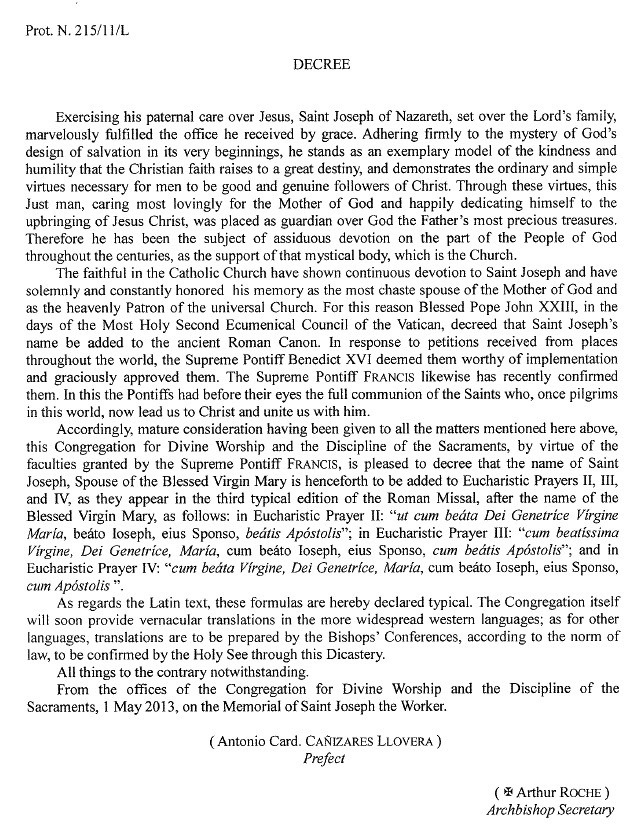
St. Joseph to be included in the Eucharistic Prayers at Holy Mass

VATICAN CITY (CNS) -- Pope Francis and Pope Emeritus Benedict XVI have a special devotion to St. Joseph and have assured that devotion regularly will be shared at Mass by Catholics around the world.

The Congregation for Divine Worship and the Sacraments said Pope Francis confirmed a decision originally made by Pope Benedict to include St. Joseph permanently in the Eucharistic prayers used at most Masses in the Latin rite.

A decree signed May 1 by Cardinal Antonio Canizares Llovera, congregation prefect, and Archbishop Arthur Roche, congregation secretary, said Pope Benedict had received petitions from Catholics around the world and approved adding after the name of the Virgin Mary, the words "with blessed Joseph, her spouse.".

Blessed John XXIII had added the name of St. Joseph to the first eucharistic prayer, known as the Roman Canon, in the 1960s. The new decree inserts his name into eucharistic prayers II, III and IV.

A congregation official told Catholic News Service June 18 that national bishops' conferences could set a date for the changes to begin if they believe that is necessary, "but because it is a matter of only adding five words, priests can begin immediately."

The decree described St. Joseph as "an exemplary model of the kindness and humility that the Christian faith raises to a great destiny, and demonstrates the ordinary and simple virtues necessary for men to be good and genuine followers of Christ."

St. Joseph, "caring most lovingly for the Mother of God and happily dedicating himself to the upbringing of Jesus," has been the subject of deep Catholic devotion around the world for centuries, the decree said.


Link to the Decree issued by the Congregation for Divine Worship

Tuesday, June 18, 2013

The Holy Priesthood - Pope Emeritus Benedict XVI & Bl. John Paul II

The Clergy shortage and the Pastoral care of Vocations 
(Section From Sacramentum Caritatis - Pope Emeritus Benedict XVI )

25. In the light of the connection between the sacrament of Holy Orders and the Eucharist, the Synod considered the difficult situation that has arisen in various Dioceses which face a shortage of priests. This happens not only in some areas of first evangelization, but also in many countries of long-standing Christian tradition. Certainly a more equitable distribution of clergy would help to solve the problem. Efforts need to be made to encourage a greater awareness of this situation at every level. Bishops should involve Institutes of Consecrated Life and the new ecclesial groups in their pastoral needs, while respecting their particular charisms, and they should invite the clergy to become more open to serving the Church wherever there is need, even if this calls for sacrifice. (78) The Synod also discussed pastoral initiatives aimed at promoting, especially among the young, an attitude of interior openness to a priestly calling. The situation cannot be resolved by purely practical decisions. 

On no account should Bishops react to real and understandable concerns about the shortage of priests by failing to carry out adequate vocational discernment, or by admitting to seminary formation and ordination candidates who lack the necessary qualities for priestly ministry (79). An insufficiently formed clergy, admitted to ordination without the necessary discernment, will not easily be able to offer a witness capable of evoking in others the desire to respond generously to Christ's call. The pastoral care of vocations needs to involve the entire Christian community in every area of its life. (80) Obviously, this pastoral work on all levels also includes exploring the matter with families, which are often indifferent or even opposed to the idea of a priestly vocation. Families should generously embrace the gift of life and bring up their children to be open to doing God's will. In a word, they must have the courage to set before young people the radical decision to follow Christ, showing them how deeply rewarding it is.


Section of Letter on Holy Thursday 1979 - Bl. John Paul II to Priests

Dear Brothers: you who have borne "the burden of the day and the heat" (Mt 20:12), who have put your hand to the plough and do not turn back (cf. Lk 9:62), and perhaps even more those of you who are doubtful of the meaning of your vocation or of the value of your service: think of the places where people anxiously await a Priest, and where for many years; feeling the lack of such a Priest, they do not cease to hope for his presence. And sometimes it happens that they meet in an abandoned shrine, and place on the altar a stole which they still keep, and recite all the prayers of the Eucharistic liturgy; and then, at the moment that corresponds to the transubstantiation a deep silence comes down upon them, a silence sometimes broken by a sob… so ardently do they desire to hear the words that only the lips of a Priest can efficaciously utter. So much do they desire Eucharistic Communion, in which they can share only through the ministry of a priest, just as they also so eagerly wait to hear the divine words of pardon: Ego te absolvo a peccatis tuis! So deeply do they feel the absence of a Priest among them!... Such places are not lacking in the world. So if one of you doubts the meaning of his priesthood, if he thinks it is "socially" fruitless or useless, reflect on this!

We must be converted every day, we must rediscover every day the gift obtained from Christ himself in the sacrament of Orders, by penetrating the importance of the salvific mission of the Church and by reflecting on the great meaning of our vocation in the light of that mission.

___________________________________________________

Let us pray for Vocations to the Priesthood in Ireland and for a deeper faith and renewal in prayer and reverence for the True Presence of Jesus Christ in the Holy Eucharist who is the source of all good and holy Vocations.  We will not be able to renew the life of the Church without a return to a more profound and deeper awareness in the True Presence of Christ who is with us in the Most Holy Eucharist.  Pope Emeritus Benedict XVI and Bl. John Paul II constantly reminded us of this in their Pontificates. 

Friday, June 7, 2013

Section of Homily from Pope Emeritus Benedict XVI on Feast of The Sacred Heart of Jesus 2010

The most important of those texts in today’s liturgy is Psalm 23(22) – “The Lord is my shepherd” – in which Israel at prayer received God’s self-revelation as shepherd, and made this the guide of its own life. “The Lord is my shepherd, I shall not want”: this first verse expresses joy and gratitude for the fact that God is present to and concerned for us. The reading from the Book of Ezekiel begins with the same theme: “I myself will look after and tend my sheep” (Ez 34:11). God personally looks after me, after us, after all mankind. I am not abandoned, adrift in the universe and in a society which leaves me ever more lost and bewildered. God looks after me. He is not a distant God, for whom my life is worthless.

Another part of this homily reads;


“Your rod and your staff – they comfort me”: the shepherd needs the rod as protection against savage beasts ready to pounce on the flock; against robbers looking for prey. Along with the rod there is the staff which gives support and helps to make difficult crossings. Both of these are likewise part of the Church’s ministry, of the priest’s ministry. The Church too must use the shepherd’s rod, the rod with which he protects the faith against those who falsify it, against currents which lead the flock astray. The use of the rod can actually be a service of love. Today we can see that it has nothing to do with love when conduct unworthy of the priestly life is tolerated. Nor does it have to do with love if heresy is allowed to spread and the faith twisted and chipped away, as if it were something that we ourselves had invented. As if it were no longer God’s gift, the precious pearl which we cannot let be taken from us. Even so, the rod must always become once again the shepherd’s staff – a staff which helps men and women to tread difficult paths and to follow the Lord.

For full text go to:  Vatican - Homily from Pope Emeritus Benedict on Feast of Sacred Heart 2010
(at Conclusion of the Year for Priests)